
Digital Membership Cards for Nonprofits, Donor Cards, and Volunteer IDs From One Salesforce Org
Membership cards, digital donor cards, volunteer IDs, and event passes all run on one Kemicard setup inside your Salesforce org. One admin manages the templates, and every scan writes back to the constituent record.
Every Digital Membership Card Generated From The Nonprofit Cloud Record That Governs It
Each card template maps to a Nonprofit Cloud (now Agentforce Nonprofit) object and a defined set of fields. Membership status, giving level, volunteer clearance, and event registration drive separate templates, while the configuration steps remain identical across programs.
Membership Cards
The membership record supplies tier, join date, and renewal date, and the template renders them on a single pass. A renewal extends the same card, and a lapse deactivates it without reissue.
Digital Donor Cards
Recognition level and cumulative giving are read from the gift records already stored in Nonprofit Cloud. When a gift posts and moves the donor into a higher level, the digital donor card updates in place.
Volunteer IDs
The volunteer record carries role, site assignment, and screening expiry, and each value maps to a field on the pass. Once screening lapses in Salesforce, the volunteer ID stops validating at check-in.
A member's first two minutes
Jennifer joins an animal rescue group, and her membership card arrives in her phone's wallet without anyone printing anything.
More on the video tutorials page.
A Single Membership Record Drives Both Issuance and Revocation of the Salesforce Membership Card
Issuance and revocation are configured on the same object, against the same field values. A renewal extends the existing card, and a lapse deactivates it, with no second template and no manual cleanup step.
- Issuance Condition on the Membership Object. A dues payment posting or an approval flipping the status field satisfies the condition, and the pass generates against that record without a queue or a batch run.
- Renewal Rewrites the Expiry Date in Place. A renewed term updates the date field on the existing pass, so the supporter keeps the card already saved to the phone.
- Tier Movement Re-Renders the Card. A change to the level field swaps the tier label and the benefit set on the pass, with no new card issued for the upgrade.
- Grace State Between Expiry and Revocation. A configured window after the renewal date keeps the card readable while the renewal is being chased, then hands it to the lapse rule.
- Lapse Deactivation From the Status Field. Once the status moves to lapsed, the pass stops validating at admission, and the record remains the only place that decision is made.
- Lifetime Memberships Issue Without an Expiry Rule. A lifetime flag on the record produces a card with no renewal date, and revocation stays available through the same status field.
- Manual Revocation From the Record Itself. A membership coordinator can revoke a single card from the member record when a membership is cancelled outside the normal cycle.
Member Engagement Without the Postage
Every push notification is a member touchpoint that costs nothing to send. For nonprofits, the installed membership card becomes the most efficient channel in the toolkit.
- Renewal season. Sequenced lock-screen reminders replace expensive direct-mail chases — and can carry the nonprofit discount code.
- Impact moments. Campaign milestones and thank-yous land the day they happen, deepening donor connection.
- Event mobilization. Volunteer calls, gala reminders, and chapter meetings reach exactly the members involved.
- Museum & venue visits. Geofencing welcomes members at the entrance — card ready, benefits visible.
Every message here is a template — sent automatically from a Salesforce Flow, a scheduled Kemicard Connect send, or a single record, at no per-message cost.

Development Teams Manage Digital Donor Cards Without a Separate Engagement Tool
Development staff work from the campaigns and list views already used for appeals. Card issuance and notifications run off those same lists, so donor engagement stays inside the fundraising process rather than beside it.
Cards Issued From a Campaign Member List
Donors on an appeal campaign receive their card in one action from the campaign record, with no separate upload.
Notifications Targeted by the Same Segment
A push message goes to the list view that defined the appeal audience, so segmentation logic is written once.
Donor Event Access Validated Against Giving Level
Gala and preview entry checks the level field at the door, which keeps the guest list logic on the donor record.
Card Engagement Reported Beside Gift Data
Scans and notification responses appear on the donor record and roll into the same dashboards used for appeal performance.
48 Heritage Square
Lincoln, NE 68508
Member previews: first Thursdays
The Back of the Card: Impact and Benefits Together
Member benefits, tax-receipt details, and ways to get involved — carried on the card that proves membership.
Every row is a back-of-pass field configured in Kemicard Studio — plain text, tappable links, and phone numbers, all mapped to Salesforce data. Campaign updates and new member benefits roll out to every wallet the moment you publish them.
Supporter Programs Across Nonprofit Sectors Map Onto One Card Engine
The sector has no bearing on setup. Plan selection follows annual card volume, so a small historical society and a national health charity configure identically and differ only in how many cards are issued each year.
- K-12 Educational Institutions. Parent association memberships and family event passes issued from the household record.
- Environmental and Conservation Organizations. Member and steward cards used at preserves, trailheads, and site gates.
- Animal Welfare Organizations. Foster and volunteer credentials alongside adopter member cards on the same contact records.
- Human Services Organizations. Volunteer IDs carrying shift assignment and screening expiry from the volunteer record.
- Healthcare and Public Health Nonprofits. Donor recognition cards showing society standing from cumulative gift rollups.
- Grantmaking Foundations. Donor and fundholder cards reflecting advised fund designation and recognition level.
Less Fulfillment Overhead, More Member Connection
- Built on NPSP & Nonprofit Cloud — passes drive from the Contacts and membership objects you already maintain.
- Replace print fulfillment — no card printing, mailing, or reissue costs; renewals update the card in place.
- Hybrid for holdouts — keep plastic for members who want it, with identical barcodes so both scan the same.
- Event check-in — chapter meetings and galas scanned with the Kemicard Scanner, attendance feeding post-event stewardship.
- 10% nonprofit discount — on every plan, every year.
 Unity Alliance
 Hope Harbor Volunteers
The Members You Cannot Currently Reach
Every membership organisation has two lists: the people who renewed and the people who quietly did not. The second list is usually larger, and most organisations can do nothing with it because the only channel they had was a card that went in a drawer.
- A lapsed member still carries the pass. That is a channel to someone who has already demonstrated they care about the cause.
- Attendance and engagement become visible. A member whose activity has halved is addressable while the relationship is still recoverable.
- Renewal is a push, not a posting. No print run, no envelope, no wait for the reply-paid card that never comes back.
- Recognition can be shown. Giving level, years of membership and volunteer status on the pass — the acknowledgement that costs nothing and matters.
Nonprofits, in practice
For membership nonprofits, the card is the relationship made tangible. Kemicard turns NPSP and custom membership records into wallet cards that renew, upgrade, and communicate — without the print-and-mail cycle that eats program margins — and without the plastic waste, an environmental win your annual report can cite. The full case is in our article Why Nonprofits Should Go Digital. NAACP, FASNY, GSHAC, and the Museum of New Mexico Foundation all run member cards on this pattern today.
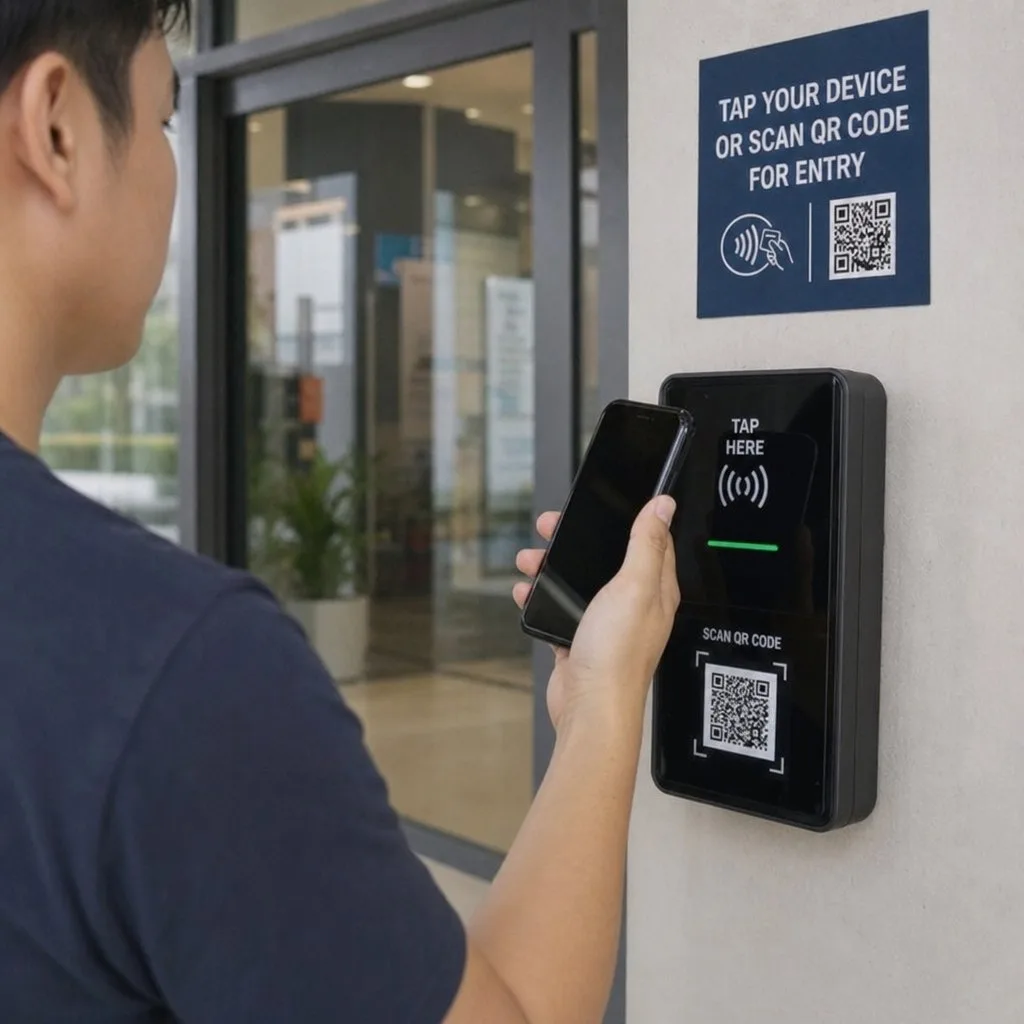
The mechanics fit nonprofit operations: membership activates (from a donation form, Fundraise Up, or manual entry) and a Flow issues the card and enrollment email automatically; tier changes re-theme the card; expiry dates drive renewal reminders on the lock screen at a fraction of direct-mail cost. Scanning at chapter meetings, museum entrances, or annual conventions records attendance to the member record — engagement data most nonprofits have never had.
Donor recognition works the same way: a named recognition pass for major donors, updated with campaign milestones, is a renewable touchpoint rather than a one-time plaque. Volunteer credentials with QR check-in give program staff real hour tracking. And because Kemicard is priced by passes issued — with a 10% nonprofit discount on every plan — a 5,000-member organization starts at the entry tier without an enterprise procurement cycle.
Membership Management Software for Nonprofits
Most non profit organization membership management software solves the administrative half well — joining, renewing, invoicing — and stops at the point where the member actually experiences the membership. The card, if there is one, is a print job.
That gap matters because the card is the only part of the membership a member touches between renewals. A card that reflects their giving level, opens members' events, and can carry a message to their lock screen is doing engagement work that no admin system can do from a database.
If your association already runs Salesforce — Nonprofit Cloud, NPSP or a custom model — you do not need free membership management software bolted alongside it. You need the membership record you already maintain to reach the member's phone. That is the whole of what Kemicard adds.
Frequently Asked Questions
No. Kemicard reads standard and custom Salesforce objects, so orgs still running a custom membership model or a Sales Cloud implementation can map templates to whatever objects hold supporter data. Nonprofit Cloud simply means the objects are already structured.
No app, no login, and no account creation. The add-to-wallet link opens Apple Wallet or Google Wallet directly, which is why adoption rates run higher than portal-based member programs.
Those supporters stay on a printed card, and the two approaches run side by side. The Salesforce record remains the source for both, so reporting is not split across two systems.
Pricing follows the number of cards issued per year rather than the number of staff users, and a nonprofit discount applies. Plans start at the entry tier and scale by annual card volume.
Kemicard installs from the Salesforce AppExchange into an existing org, and configuration happens through templates and field mapping rather than code. No middleware or external database is introduced.
Only the fields mapped onto a pass are rendered to the wallet, and Salesforce remains the system of record. Kemicard operates inside Salesforce's SOC 2 Type II environment, and a Data Processing Addendum is available for procurement review.
Yes. An initial rollout issues from a list view or campaign covering current members, and distribution runs over email, SMS, or a QR code at a physical location.
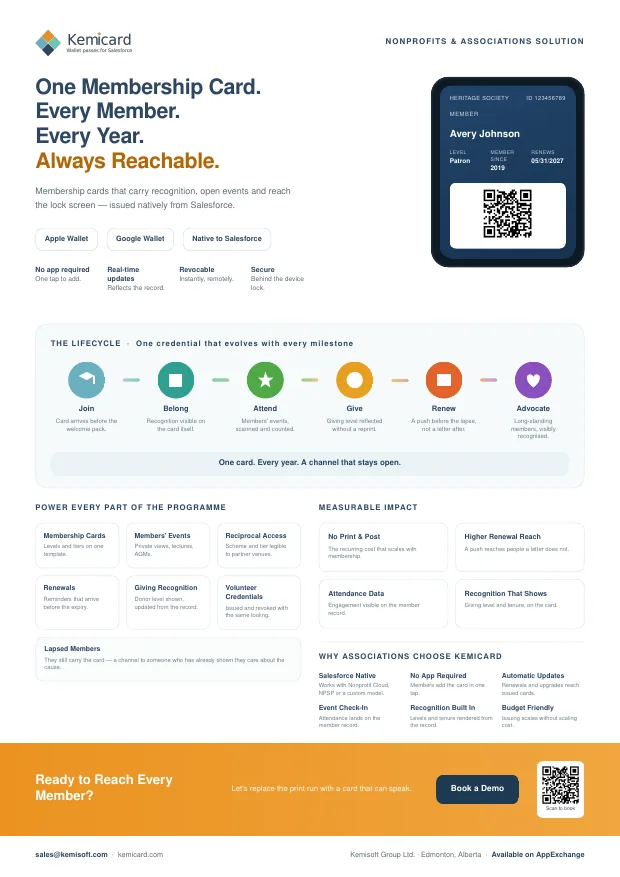
Nonprofits & Associations — the brochure
A one-page summary for a conference table or an email, or the six-page version for the colleague who has to approve it. Both cover what you can issue, how it works, and the push and back-of-card examples for nonprofits and associations.

 Get It on AppExchange