Digital Museum Membership Cards Issued From Your Salesforce Org to Apple Wallet and Google Wallet
Kemicard turns the membership records in your Salesforce org into digital museum membership cards in Apple Wallet and Google Wallet. Tier, expiry date, guest allowance, and cardholder name map to fields your membership team already maintains.
 Try on AppExchange
Museum Card Programs Run on One License and One Annual Card Volume
Card type has no effect on the license. Membership cards, guest passes, timed entry tickets, and docent IDs draw on one annual allowance, counted the same way regardless of which program issued them.
Individual and Dual Membership Cards
The standard tiers issue from the membership record with tier name, member since year, and expiry rendered on the pass. A dual membership produces two named cards against one record.
Patron and Donor Circle Cards
Upper tier cards carry lounge access and preview invitations as entitlement fields on the back of the pass. Movement into a higher circle rewrites the existing card instead of issuing a second one.
Guest Passes
Complimentary admissions attached to a membership are issued as separate passes that can be forwarded to the guest. Each is redeemed at entry and logged against the member who holds them.
Special Exhibition Tickets
Ticketed exhibition entry lands in the same wallet as the membership card, with member pricing applied from the tier field. Attendance writes back to the visitor record for exhibition reporting.
Membership Cards Are a Cost Centre That Should Not Be One
Cultural institutions print and post membership cards on a rolling annual cycle. Card stock, the printer, the envelopes, the postage, the returned mail, and a replacement process for everyone who loses one — none of it does anything for the visitor, and all of it scales with the size of the programme.
- The recurring spend goes away. A wallet card costs the same to issue whether you have four hundred members or forty thousand.
- Replacement stops being an event. A lost card is a resent link rather than a phone call, a print run and a wait.
- New members are members immediately. Someone who joins at the desk or online holds the card before they walk into the first gallery, which is the moment the decision felt good.
- Plastic leaves the programme, which for an institution with a sustainability commitment is a visible piece of follow-through rather than a statement.
Museum Membership Management Stays in Salesforce Through Every Renewal Cycle
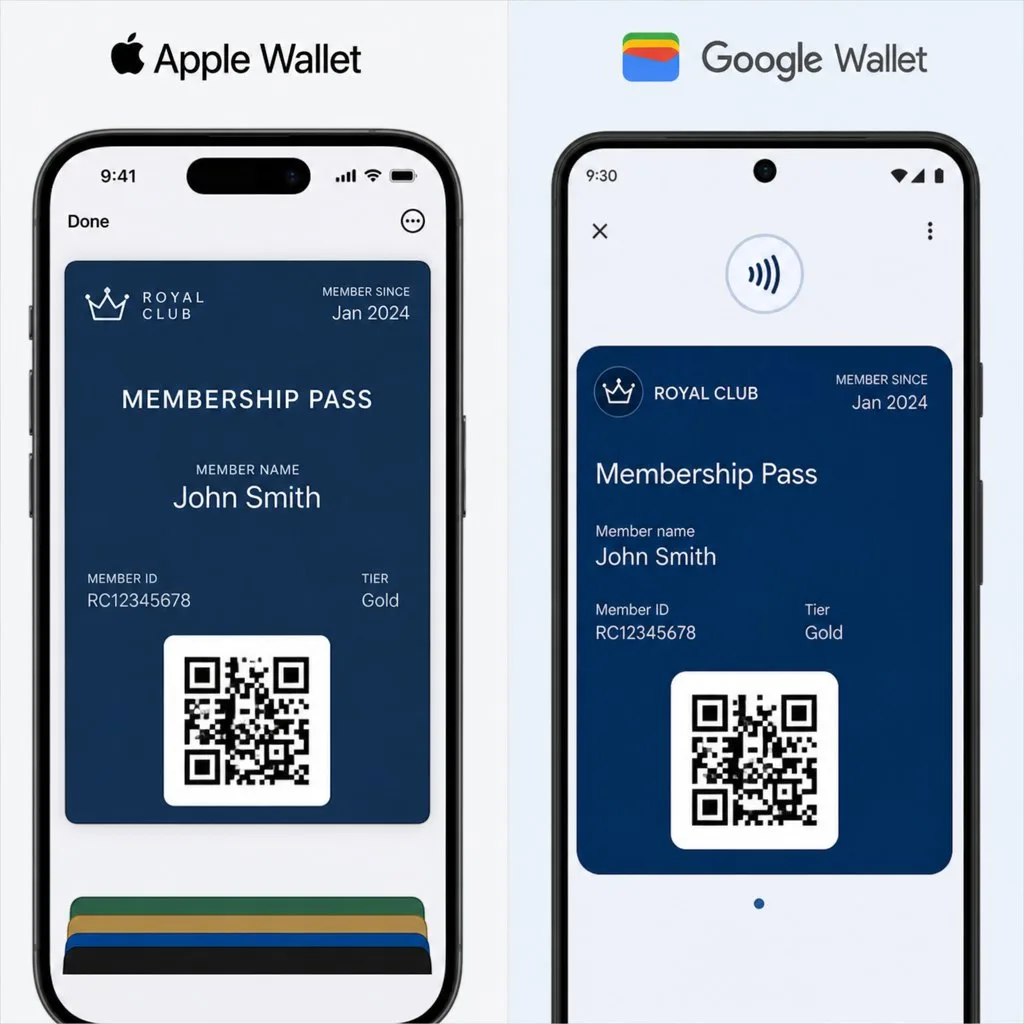
The membership calendar drives everything the card does. Anniversary dates, grace periods, and reinstatement rules are already configured in Salesforce, and the pass reads its state from them.
- Anniversary and Calendar Year Terms Both Supported. Whether the expiry date follows the join anniversary or a fixed calendar year, the card reads the date held on the record. No separate configuration is needed for museums that run both models across tiers.
- Short Term and Seasonal Memberships. Exhibition-run and summer memberships use the same template set with a shorter term, so a temporary offer needs no separate build.
- Renewal at the Desk Updates the Card Before Entry. A member renewing at admissions has the record updated on the spot, and the pass in their wallet reflects the new term before they reach the gallery.
- Auto-Renew Memberships Never Reach a Lapse State. Where a recurring payment is on file, the expiry advances on each successful charge, and the card carries on without a renewal action.

The Members You Only Hear From Once a Year
Most museum memberships are bought once and renewed automatically until they are not. The institution finds out a member has drifted at the moment they fail to renew, which is far too late to do anything about it.
A card that can speak changes the shape of that relationship. Members hear about the private view, the family trail and the lecture series without being on the mailing list, and the institution can see who came.
That visit data matters more here than in most sectors, because it is the evidence development teams need. A member who has attended four events this year is a different conversation from one who has attended none, and until now most institutions could not tell the two apart.
Member Benefits Change Centrally, and Every Card Reflects It the Same Day
Benefits change more often than memberships do. Café discounts, partner offers, preview access, and shop rates are values on the pass, so an edit in Salesforce reaches every issued card the same day.
Exhibition Ticket Allotments per Tier
The number of member tickets included for a ticketed show differs from one exhibition to the next. That allowance is a field value on the card, set when the show goes on sale and retired when it closes.
Reciprocal Network Codes at Annual Renewal
Reciprocal agreements are renegotiated yearly, and institutions join or leave the network. The codes on the card are updated once, and every member's pass carries the current network standing.
Audio Guide and Catalogue Member Pricing
Included audio guide access and member catalogue pricing shift with each exhibition. Both render as entitlements the front desk can read without checking a membership handbook.
Guest Admission Allowance per Tier
The guest admissions included in each tier are shown on the pass so admissions staff can read the entitlement at the door. Redemption rules follow the museum's own policy configuration.
The Card Should Look Like the Institution
Museums care about design more than most organisations, and rightly — the membership card is a small piece of the institution that a member carries around. Three things decide whether it looks considered or generic.
- The mark, not the full lock-up. A pass appears first as a compressed row about thirty pixels high. Fine lettering becomes a smudge; the symbol survives.
- A colour that is yours. The pass sits next to bank and airline cards. An institutional navy competes with all of them; a distinctive secondary colour does not.
- One fact on the front. Tier and expiry, or the member's name. Everything else — reciprocal schemes, opening hours, the members' room, the phone number — belongs on the back, where there is room.
The back of the pass is the part institutions underuse most. It is a permanently available help page for the questions the front desk answers all day.
A Member's Ticket and Membership Card Are Scanned at the Same Door
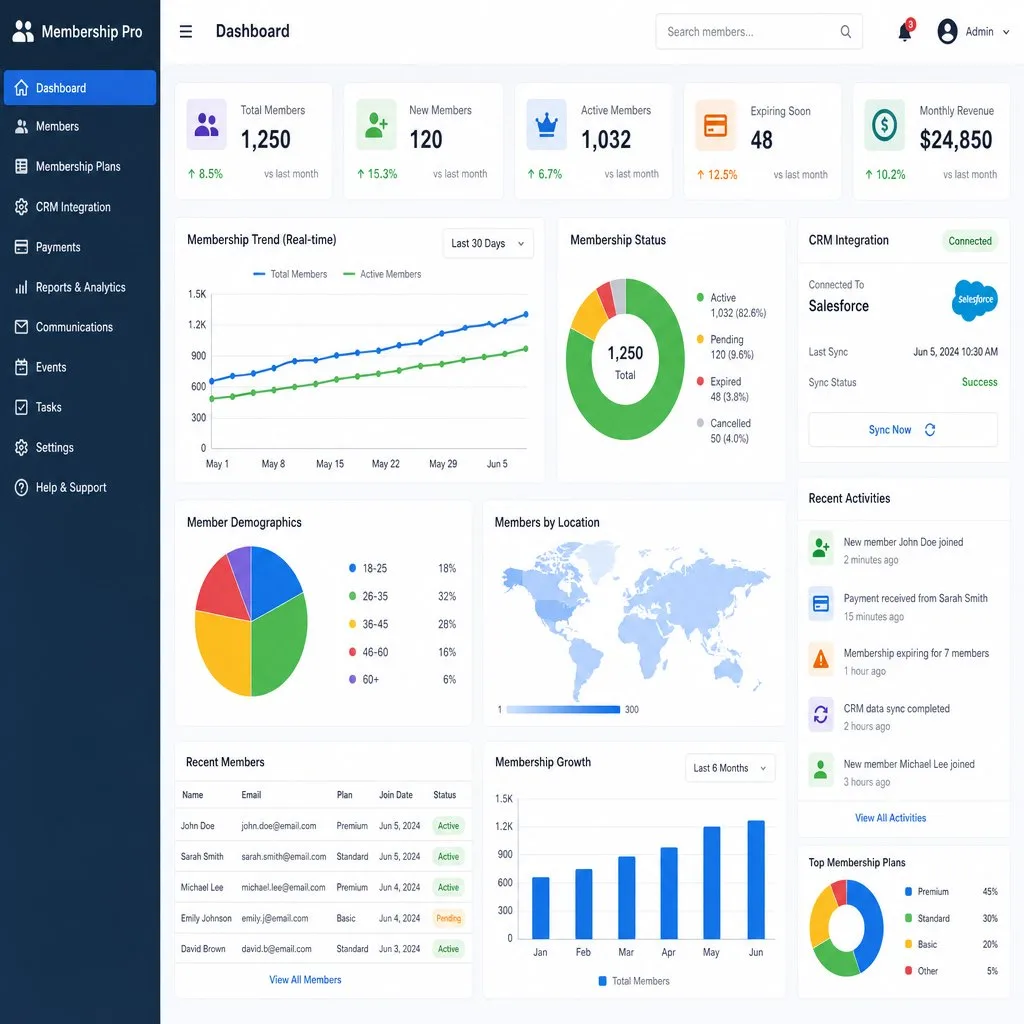
Both passes follow the same validation path. A member arriving for a ticketed exhibition has ticket validity and membership status checked in a single scan, with no name lookup at the desk.
- One Scan Resolves Both the Ticket and the Membership. Ticket validity and membership status return together, so a member attending a paid exhibition is cleared in a single action at the door.
- Scanning From Staff Phones. Admissions staff and weekend volunteers validate passes on their own devices, or from an Experience Cloud site without full Salesforce access, which avoids buying a scanner for every entrance during a busy exhibition run.
- Repeat Scans Flagged at the Door. A pass presented twice is flagged during validation, and the museum's own rule decides whether that blocks entry or simply records a second visit.
- Lapsed Cards Surface a Renewal Conversation. An expired membership shows at the door rather than failing silently, which turns a refused scan into a renewal taken at the desk.
- Attendance Written to the Visitor Record. Each entry logs against the record behind the pass, which builds exhibition attendance and member visit frequency without an import.
12 Gallery Walk, Edmonton, AB T5K 2P1
Thursdays until 9:00 PM · Closed Mondays
The Back of the Card: What Members Actually Look Up
Opening hours, the members' room, exhibition booking and the reciprocal scheme — the four things members ask the front desk.
The reciprocal row matters most: it has to be legible to somebody at another institution's desk who does not know your programme. Put the scheme name and the tier where a stranger can read them.
Museums and galleries, in practice
Cultural institutions sit at an awkward intersection: they run a membership programme like an association, a ticketing operation like a venue, and a fundraising programme like a charity, usually with one small team and one database holding all three. That is precisely why issuing from the record rather than from an export matters here. The member, the ticket buyer and the donor are frequently the same person, and any system that treats them as three records will eventually send that person the wrong message.
Timed entry has made this sharper. A headline exhibition with capacity limits needs a ticket that can be checked, changed and counted, and members expect their membership to grant access without buying one. Both are passes issued from the same contact record, so the door scans one credential and the system knows which entitlement it represents.
Reciprocal admission schemes are the case worth planning for early. If your membership grants entry to partner institutions, the pass has to make the tier legible to somebody at another organisation's desk who does not know your programme. That is a design decision — put the scheme name and the tier where a stranger can read them — rather than a technical one.
Kemicard runs inside Salesforce, so if your memberships, ticketing and giving already live there, the card renders from those records directly. See membership cards, event ticketing and nonprofits and associations.
Frequently Asked Questions
Kemicard is a Salesforce application, so a Salesforce org is required. Museums running a separate ticketing or fundraising system alongside Salesforce for museums typically sync membership records into Salesforce and issue cards from there.
No. Kemicard issues and validates wallet passes, and it does not sell tickets or hold capacity. Timed entry slots are booked in whichever system handles that today, and the resulting record produces the pass.
Reciprocal membership standing is rendered on the card so partner staff can read eligibility visually. Live validation against the issuing museum's Salesforce org is not available to a partner site, so reciprocal checks follow the network's own verification rules.
Plans start at several thousand cards a year, so a gallery membership card programme with a few hundred members will find the entry plan larger than it needs. Institutions issuing thousands of cards a year get the clearest value.
Any smartphone or tablet with a camera can scan passes, and existing barcode scanners that read QR codes also work. No proprietary reader is required for the wallet pass itself.
Printed cards continue alongside digital ones, and both draw on the same Salesforce record. Reporting stays unified because the record, rather than the card format, holds membership status.
Kemicard installs from the Salesforce AppExchange into an existing org, and configuration happens through templates and field mapping. No middleware, external database, or custom development is introduced.
Only the fields mapped onto a pass render to the wallet, and Salesforce remains the system of record. Kemicard operates inside Salesforce's SOC 2 Type II environment, and a Data Processing Addendum is available for procurement review.
Site values on the record drive branding and entitlement variants, so a museum with several venues issues site-specific cards without separate installs. Reporting stays consolidated across sites.
Sources: Apple's Human Interface Guidelines: Wallet and Wallet Passes documentation; Google's Google Wallet API documentation.
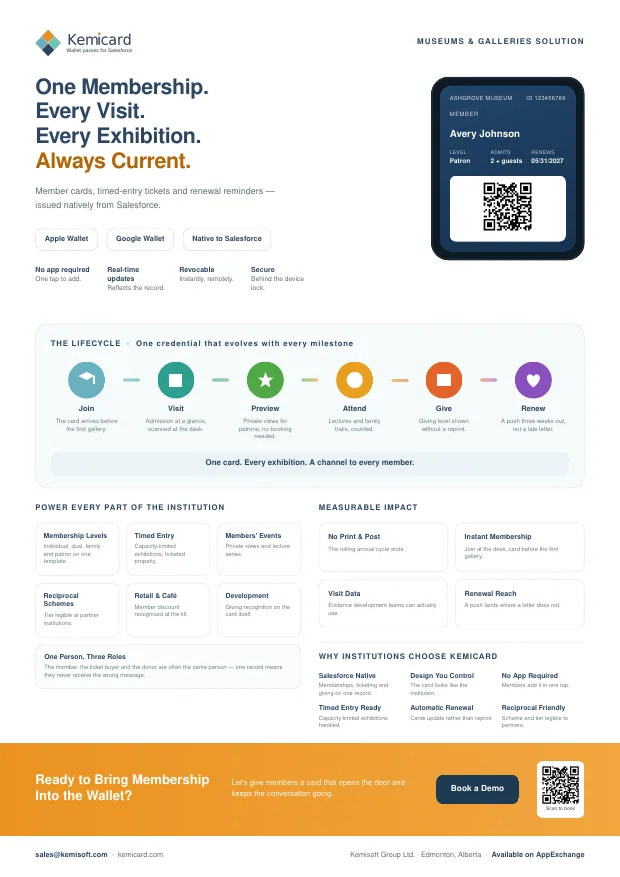
Museums & Galleries — the brochure
A one-page summary for a conference table or an email, or the six-page version for the colleague who has to approve it. Both cover what you can issue, how it works, and the push and back-of-card examples for museums and galleries.