

Concert Ticketing: Controlling What Happens After the Sale
 By the Kemicard team
Selling out is the easy problem. The hard one starts afterwards: tickets resold at four times face value, a door queue that stretches round the block because half the audience is searching an inbox, and no reliable idea of who is actually in the room.
The resale problem, stated properly
Secondary-market resale is not primarily a technology failure — it is an economics one. A ticket priced below what the market will pay creates an arbitrage, and someone will take it. Technology cannot remove the incentive; it can only make capturing it harder and slower than it is worth.
- Named tickets raise the cost of resale considerably, because the buyer now needs the name to match or the seller needs to transfer properly.
- Rotating or single-use codes defeat the screenshot trade, which is the low end of the market.
- Official transfer is the underrated control. If there is a legitimate way to pass a ticket to a friend, most people use it, and you keep visibility of who is coming.
- Delayed delivery — issuing the live credential close to the event — shrinks the window for a secondary market to form.
None of these are absolute. Treat them as friction, priced against how much resale actually costs you.
Why the door backs up
Watch any general-admission queue and the pattern is the same. The slow entries are not people being awkward; they are people whose ticket is a PDF in an email, on a saturated network, outside a venue.
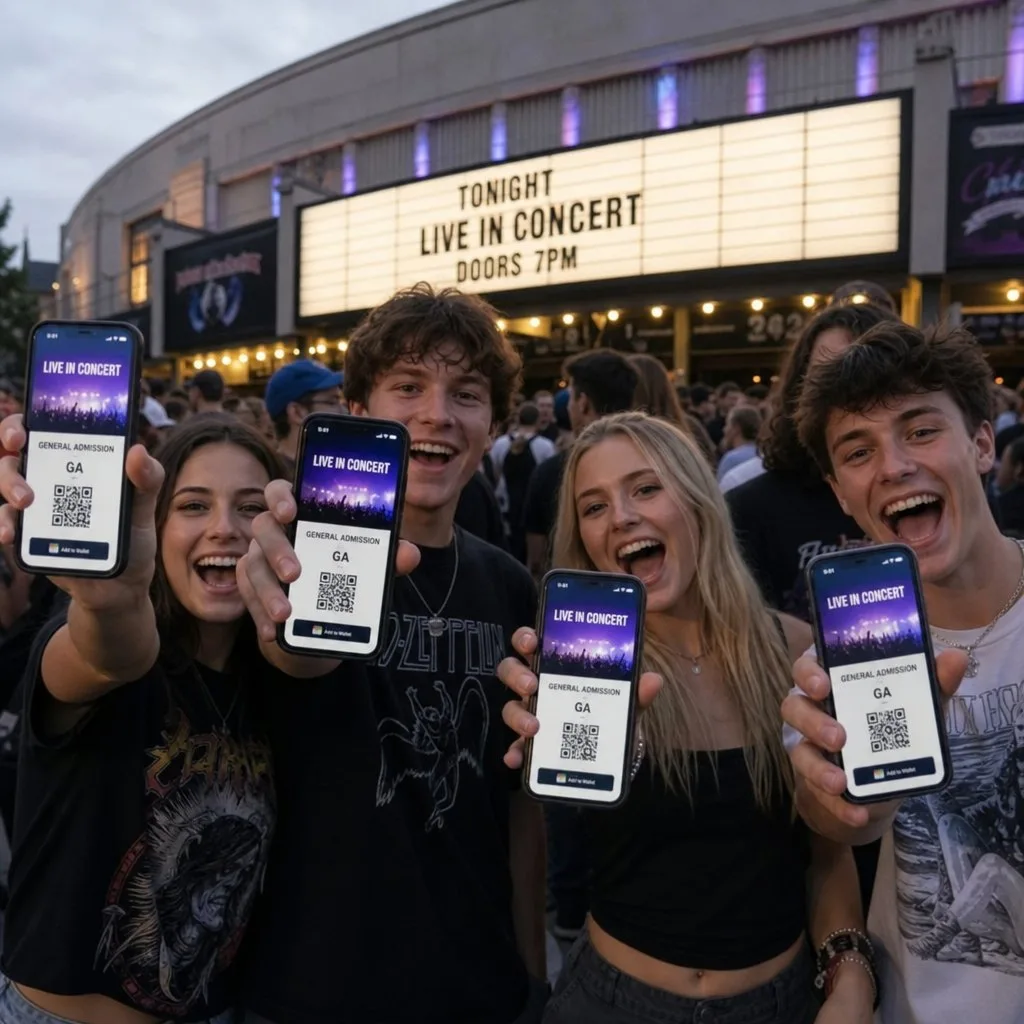
A pass in the wallet is one swipe from the lock screen, works with no signal at all, surfaces itself by time and location, and brightens the screen for the scanner. Same barcode, same show — the difference is entirely where the ticket lives.
The ticket keeps working after it is issued
This is the property that separates a pass from a PDF, and for live events it is worth more than the printing saved.
- Door times and set times reach everyone holding a ticket, including the people already travelling.
- Gate and entrance changes land before the crowd arrives at the wrong one.
- Upgrades — a general admission ticket becoming VIP — update in place rather than requiring a reissue.
- Weather and safety messaging reaches an audience you otherwise have no direct channel to.
Multi-date tours and season passes
A tour is where per-show PDFs break down completely. A holder with six dates has six attachments and will find the wrong one at least once.
Issued as passes, each date can carry its own relevance rule so the right one surfaces on the right night, or a season credential can carry the entitlement and be scanned repeatedly. Both are cleaner than six emails.

Knowing who was in the room
Scan data is the only reliable record of attendance, and for a venue or a promoter it is the basis of nearly every commercial conversation afterwards — sponsor reporting, capacity planning, and knowing which audience segments actually turn up rather than merely buy.
If those scans write back to your CRM, the follow-up is segmentable: attendees, no-shows, and the people who came to three shows this year. See attendance tracking.
Where the record lives
Kemicard issues tickets from the Salesforce record, so a scan updates the same object your team already works in — no reconciliation after the show. See event ticketing and events and entertainment.
FAQ
- Can we stop resale entirely? No. You can make it expensive and slow enough that most of it stops being worthwhile.
- What about attendees without smartphones? Keep a box-office collection route. It is a small minority and the economics still work.
- Do scanners need internet? Live validation does. Confirm your scanning app queues offline before a venue with poor signal proves it does not.
- Can one person hold tickets for a group? Yes — multiple passes sit in one wallet, though named-ticket policies may require each person present separately.
Explore Kemicard
Product & solutions
Issue Tickets From Your Own Event Records
Book a demo, test drive Kemicard, or start a free 30-day trial.
 Start Free Trial